
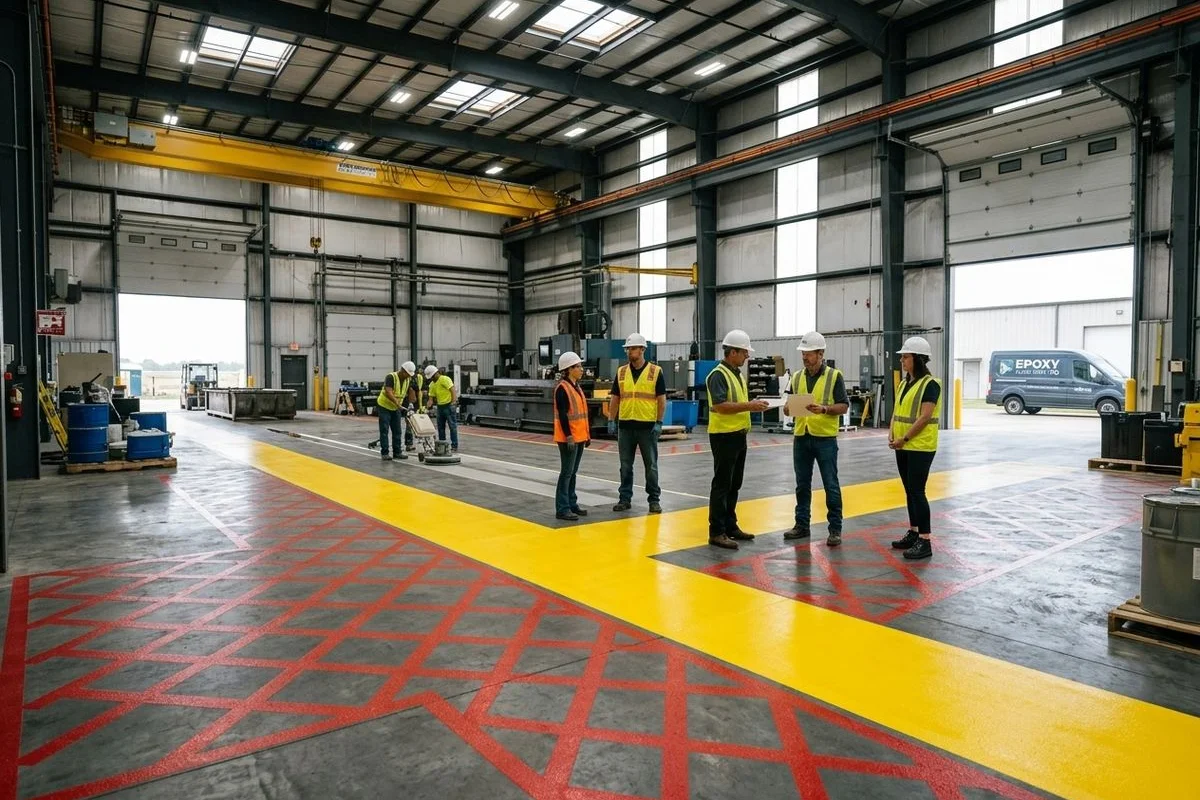
Expert OSHA-Compliant Safety Striping & 5S Floor Markings
OSHA-compliant floor striping, 5S lean markings, non-slip coatings, and pedestrian safety demarcation for industrial and manufacturing facilities.
OSHA Floor Markings: A Safety Requirement, Not an Aesthetic Choice
Every year, forklift-pedestrian incidents account for a significant portion of serious industrial injuries in the United States. OSHA data consistently shows that inadequate traffic separation — particularly the lack of clearly marked pedestrian corridors — is a primary contributing factor. OSHA 29 CFR 1910.22 and 1910.178 require that facilities clearly delineate pedestrian pathways, equipment staging zones, and hazard areas. But compliance is a floor — not a ceiling.
Beyond the regulatory minimum, well-designed and consistently maintained floor markings are a practical safety management tool. They communicate expected behavior to workers, define traffic flow patterns, and create visual organization that reduces the cognitive load on employees navigating a busy facility. When everyone knows exactly where pedestrians walk and where forklifts travel, incident rates fall — and the data supports this across every industry we work in.
Epoxy Flooring Pro installs OSHA-compliant floor marking systems using high-build epoxy and fast-cure polyurea that outlast standard traffic paint by a factor of five or more. We work with your safety team to develop a layout that satisfies regulatory requirements, aligns with your operational logic, and can be maintained over the long term without annual repainting cycles.
Why Floor Paint Fails — and Why Epoxy Markings Do Not
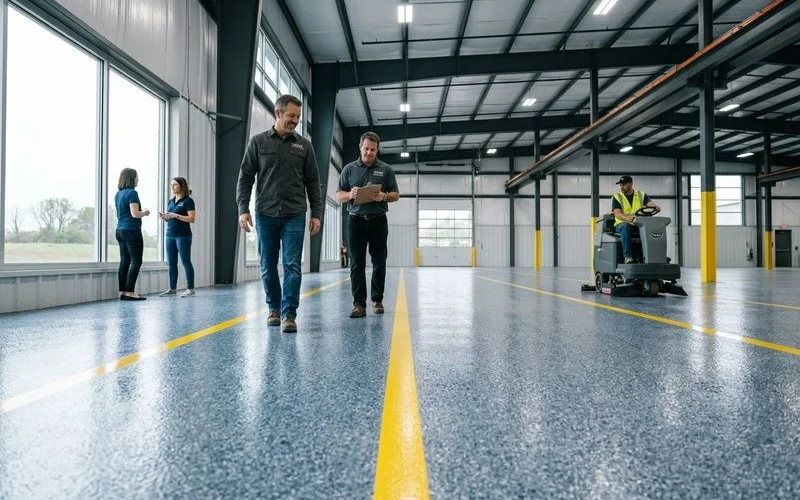
The fundamental problem with standard floor traffic paint in industrial environments is film thickness. Standard traffic paint is applied at 2–4 mils DFT (dry film thickness). A forklift tire, loaded to 10,000–20,000 lbs, applies enormous point pressure to whatever surface it rolls over. At 2–4 mils, traffic paint has essentially no resistance to this abrasion — it simply wears away, often peeling and failing within weeks in high-traffic intersections.
The Thickness Advantage
Our high-build epoxy marking systems are applied at 20–30 mils DFT after thorough surface preparation and primer application. This is not just a thicker version of the same material — it is a fundamentally different product category. High-build epoxy:
- Bonds chemically to the prepared concrete substrate
- Cures to a hard, cross-linked polymer matrix
- Resists abrasion from steel and polyurethane forklift tires
- Maintains edge definition through years of traffic
- Does not crack or peel under thermal cycling
For extreme traffic conditions, we use polyurea marking materials that offer even higher hardness and impact resistance, with the added benefit of rapid cure times (traffic-ready in 1–2 hours) that minimize operational disruption during installation.
Surface Preparation is Critical for Markings Too
One of the most common reasons floor markings fail prematurely — even good-quality epoxy products — is inadequate surface preparation. Grinding the stripe path to clean, profiled concrete is as essential for markings as it is for full epoxy coating systems. We grind all stripe paths to remove existing paint, contamination, and surface laitance before applying any marking material. The additional cost of proper preparation is recovered many times over in marking longevity.
5S Floor Marking Systems for Lean Manufacturing
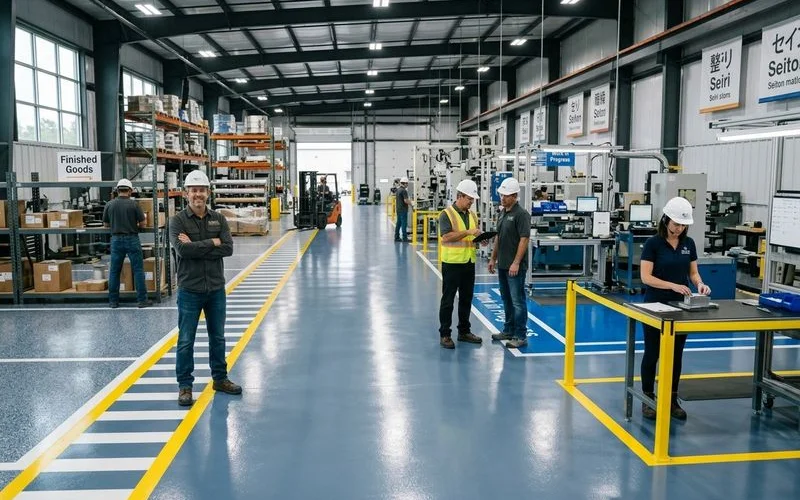
5S lean manufacturing programs require that every piece of equipment, every storage location, and every workflow path have a defined, marked, and consistently maintained home position. Floor markings are the physical implementation of the ‘Set in Order’ principle — making correct organization the default by making it visually obvious.
5S Marking Elements We Install
Aisle and Pedestrian Lanes: Yellow high-build epoxy lanes at code-compliant widths (typically 48–72 inches for forklift aisles, 24–36 inches for pedestrian-only corridors) with clearly defined edges.
Workstation Boundaries: White outlines defining the footprint of each workstation, machine, or assembly area. These boundaries communicate clearly where equipment belongs and make it immediately visible when items have migrated out of position.
Material Staging Areas: Outlines and labels for WIP buffers, incoming material staging, finished goods staging, and first-in-first-out (FIFO) lane structures. Color coding distinguishes zone types.
Equipment Home Positions: Precise outlines for carts, mobile equipment, pallet jacks, and other items that need to return to a specific location. Often includes a text label stenciled or embedded in the marking system.
Shadow Board Locations: Floor outlines marking where shadow boards (tool organization boards) are positioned. These ensure shadow boards stay in their designated position and are replaced if temporarily moved.
Waste and Recycling Zones: Clearly marked areas for recycling bins, waste containers, and scrap collection. Often color-coded to distinguish waste streams.
Working from Your 5S Documentation
If your organization has developed 5S layout drawings, we work directly from those documents to ensure the floor implementation matches your plan exactly. If you are initiating a 5S program and don’t yet have layout documentation, we can facilitate a layout planning session with your team to develop the floor marking specification before installation begins.
Non-Slip Coatings for Pedestrian Safety Zones
Slip and fall incidents are among the most common workplace injuries, and slippery industrial floors — particularly in areas adjacent to material handling zones — are inherently high-risk. In areas where floors become wet, where lubricants or other liquids may be present, or where worker safety demands a higher level of assured traction, we install non-slip coatings as part of the marking system.
Our non-slip systems use aluminum oxide or silicon carbide aggregate broadcast into the wet marking material. The aggregate particle size and coverage rate determine the measured DCOF (Dynamic Coefficient of Friction). We target DCOF values appropriate to the specific application:
- General industrial pedestrian areas: DCOF ≥ 0.42 (ANSI A137.1 standard for level dry surfaces)
- Wet process areas: DCOF ≥ 0.60
- Ramps and inclines: DCOF ≥ 0.80
Aggregate-bearing marking systems maintain their slip resistance as long as the aggregate particles remain embedded in the matrix — typically years, not months.
Color Standards and ANSI/ASSP Compliance
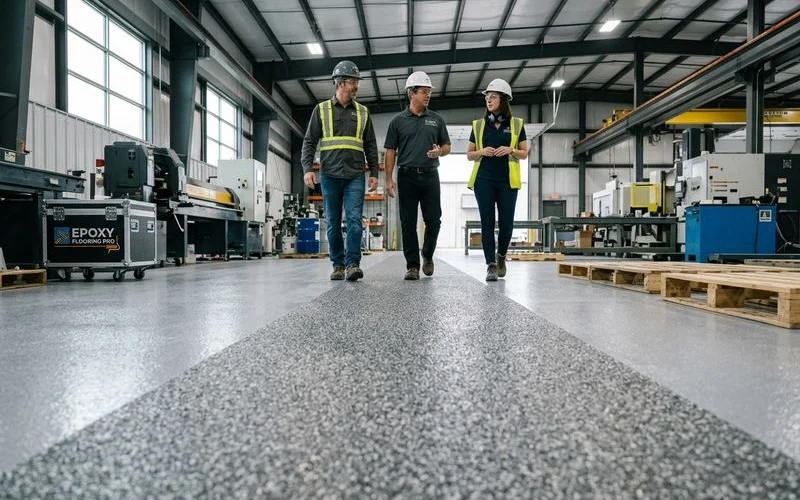
While OSHA does not mandate a specific national color standard for industrial floor markings, ANSI/ASSP Z535 provides the industry-recognized framework that most safety professionals and auditors use. Adherence to this standard ensures your markings communicate consistently with industry expectations and with workers who may transfer from other facilities:
| Color | ANSI Z535 Application |
|---|---|
| Yellow | Caution — physical hazards, aisle boundaries, forklift lanes |
| Red | Danger — fire equipment, emergency stops, restricted zones |
| Orange | Warning — material to be inspected, quarantined goods |
| White | General — workstation boundaries, finished goods areas |
| Green | Safety — first aid, safety equipment, emergency exits |
| Blue | Notice — informational, non-hazard items |
| Black & Yellow | Physical hazard — posts, columns, low clearance hazards |
We design your complete marking system to this standard and provide a color legend in the documentation package for incorporation into your safety program materials and new employee orientation.
Contact our safety striping team to schedule a facility walk-through and develop an OSHA-compliant marking layout for your operation.
What's Included
Our OSHA Safety Striping Installation Process
Facility Safety Assessment and Layout Design
We review your existing floor layout, pedestrian traffic patterns, forklift routing, emergency egress paths, and any OSHA citations or audit findings related to floor markings. Working with your safety manager, we develop a striping layout plan that addresses all regulatory requirements and operational logic before any marking begins.
Surface Preparation and Cleaning
Existing worn striping, oil contamination, and surface laitance are removed by diamond grinding or scarifying in the stripe paths. Proper surface preparation ensures the new marking material bonds to concrete rather than to a contaminated surface — which is why painted lines fail within months while our epoxy markings last for years.
Layout and Marking
Stripe paths are laid out using chalk line and measuring tools against established reference points. For 5S programs and shadow board locations, we work from your CAD drawings or help you develop the layout from scratch. Complex shapes, logos, and graphics are masked using precision tape before material application.
Epoxy or Polyurea Application
High-build epoxy or fast-cure polyurea is applied by roller to the prepared, masked stripe paths. Stripe thickness is specified to survive forklift traffic — typically 20–30 mils DFT, far exceeding the 2–4 mils of standard traffic paint. Anti-slip aggregate is broadcast into the wet material in pedestrian zones.
Topcoat and Anti-Slip Application
Where anti-slip performance is required, aluminum oxide aggregate is broadcast into the wet material and back-rolled to embed the particles before an additional sealer coat locks the aggregate in place. This creates a durable, textured surface that maintains its DCOF (Dynamic Coefficient of Friction) rating under wear.
Final Inspection and Documentation
Completed markings are inspected against the approved layout plan. We provide a photographic record of all installed markings and a written report confirming compliance with OSHA 29 CFR 1910.22 requirements. Documentation can be included in your OSHA compliance records.
Why Choose Epoxy Flooring Pro
OSHA Regulatory Knowledge
We know the OSHA standards applicable to industrial floor markings — CFR 1910.22, 1910.136, and 1910.178 for powered industrial trucks. We don't just paint lines where you ask us to; we identify gaps between your current layout and regulatory requirements and help you close them.
Materials That Outlast Paint
Standard floor paint — even traffic paint — fails rapidly under forklift traffic. Our high-build epoxy and polyurea systems are 10–15 times thicker and bond chemically to the concrete substrate. In high-traffic areas, our markings typically last 5–10 years compared to 6–18 months for paint.
5S Implementation Experience
We have implemented 5S floor marking systems for lean manufacturing facilities across multiple industries. We understand the logic of home positions, shadow board locations, material staging areas, and first-in-first-out lane markings — not just the application mechanics.
Minimal Operational Disruption
Floor striping does not require facility-wide shutdown. We work section by section, completing and reopening each zone before moving to the next. Polyurea systems return to service in 1–2 hours, allowing striping projects to be completed with minimal disruption to ongoing operations.
Integrated with Coating Projects
When striping is part of a larger coating or [polished concrete](/polished-concrete/) project, we integrate the striping design into the overall system specification — ensuring markings are properly embedded in or applied over the coating system and will not delaminate at the interface.
What Our Clients Say
"We received an OSHA citation for inadequate aisle markings and called Epoxy Flooring Pro to help us come into compliance quickly. Their team understood exactly what the citation required, developed a compliant layout plan, and completed the installation over a single weekend. We passed the follow-up inspection. Efficient, professional, and genuinely knowledgeable about OSHA requirements."
"We implemented a full 5S program in our assembly plant and chose Epoxy Flooring Pro for the floor marking component. Their team worked from our 5S layout drawings and installed every shadow board location, home position marker, and flow lane exactly as specified. Fourteen months later the markings look like new despite constant forklift traffic. The quality difference versus painted lines is dramatic."
"Our distribution center had virtually no pedestrian separation from forklift traffic — a serious safety problem. Epoxy Flooring Pro came in, assessed our traffic patterns, designed a sensible aisle layout, and installed the full marking system in two nights without stopping pick operations. Safety incident rate in marked areas dropped to zero. Outstanding work."
Frequently Asked Questions
What does OSHA require for floor markings in industrial facilities?
What is the OSHA-standard color coding system for floor markings?
How durable are epoxy floor markings compared to standard traffic paint?
Can floor markings be installed while operations are ongoing, or does the facility need to shut down?
What is a 5S floor marking system and what does the installation involve?
Get a Free Estimate for OSHA Safety Striping
Our project managers are ready to assess your facility and recommend the optimal osha safety striping solution.