
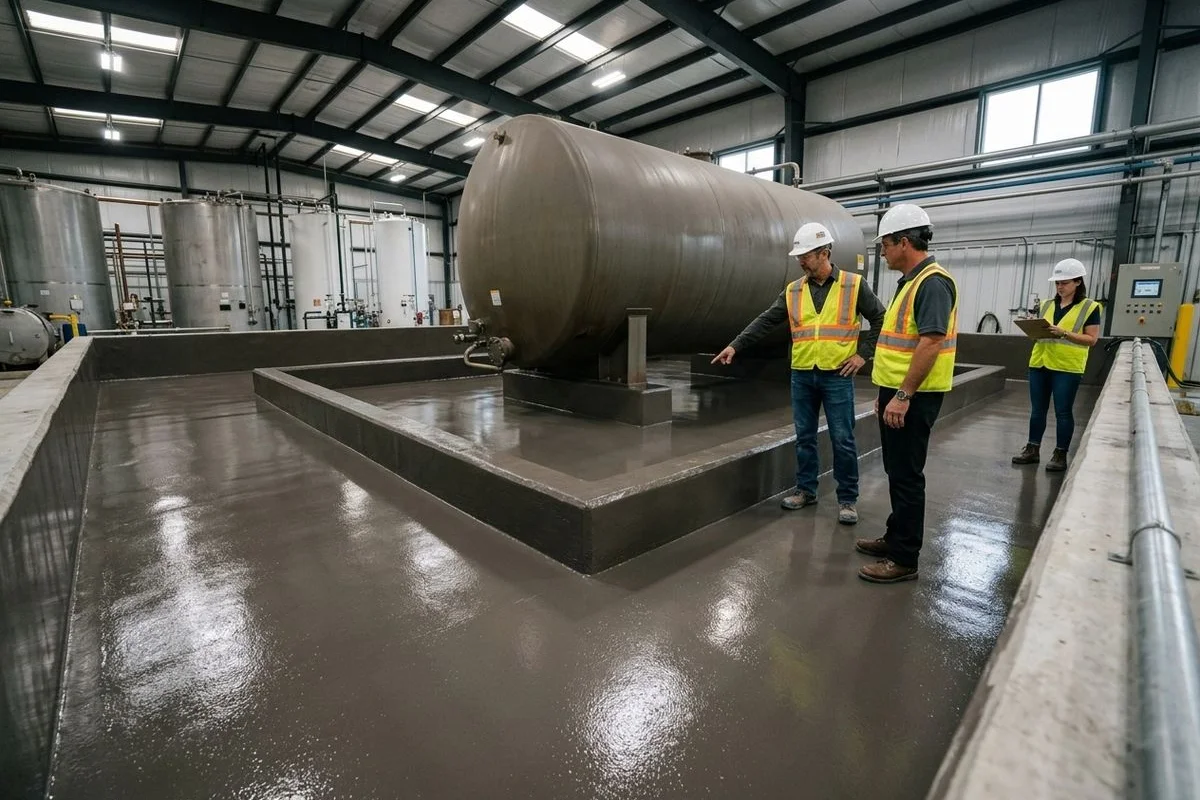
Professional Containment Coatings & Tank Lining Systems
Secondary containment linings, tank coatings, and sump linings using novolac epoxy and vinyl ester systems for chemical storage and hazardous material areas.
Secondary Containment: The Last Line of Defense Against Chemical Releases
Secondary containment systems exist because primary containment — tanks, pipes, drums, and vessels — can and does fail. Spills, overfills, equipment failures, seismic events, and operational errors release millions of gallons of hazardous chemicals into secondary containment systems every year. When those secondary containment linings perform correctly, the chemical is captured, cleaned up, and the incident is a recordable event. When the lining fails, the chemical reaches soil, groundwater, or storm drains — triggering environmental enforcement, significant remediation costs, and potentially catastrophic regulatory consequences.
The EPA’s Spill Prevention, Control, and Countermeasure (SPCC) rule and many state environmental regulations mandate secondary containment for above-ground chemical and petroleum storage. These regulations require that containment systems be impermeable and capable of holding the volume of the largest tank they protect. Meeting this standard requires more than pouring a concrete berm — it requires a protective lining system that will maintain chemical impermeability for the service life of the storage system.
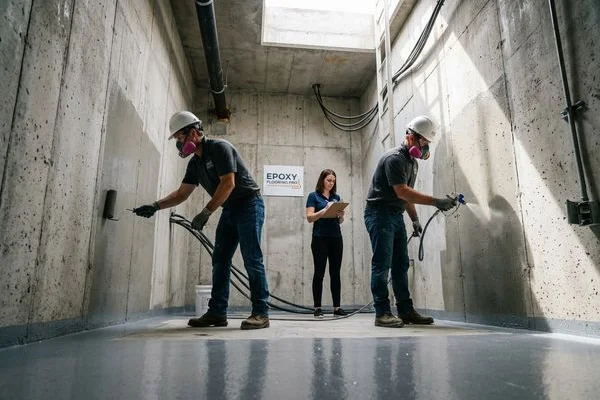
Epoxy Flooring Pro installs secondary containment linings, tank interior and exterior coatings, and waterproofing systems for chemical storage, petroleum products, waste management, and industrial process applications. Every containment project we complete includes written documentation suitable for inclusion in your SPCC plan or environmental compliance files.
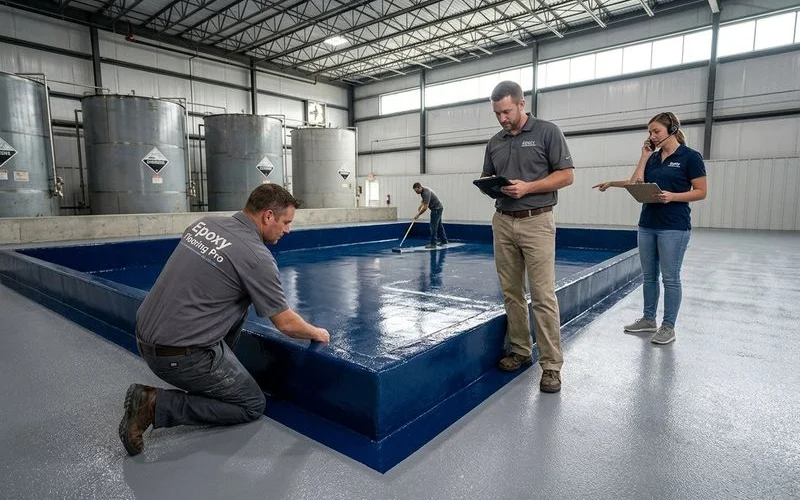
Understanding Coating Chemistry for Containment Applications
The selection of coating chemistry for containment applications is not a matter of preference — it is a technical decision driven by the specific chemical resistance requirements of the application. Using the wrong coating chemistry guarantees eventual failure.
Standard Bisphenol-A Epoxy
The foundation of industrial coating technology, BPA epoxy provides good resistance to dilute acids, alkalis, water, and many salts. It is appropriate for containment of aqueous solutions, dilute chemical spills, and petroleum products at low temperatures. Standard epoxy coating is NOT adequate for concentrated aromatic solvents, concentrated acids, oxidizing chemicals, or applications requiring elevated service temperatures.
Novolac Epoxy
Novolac epoxy — also called epoxy novolac or phenol-formaldehyde novolac — is a specialty epoxy chemistry with a higher cross-link density than standard BPA epoxy. The additional cross-linking provides:
- Resistance to aromatic solvents including toluene, xylene, MEK, and acetone
- Resistance to concentrated sulfuric acid (up to 70%), hydrochloric acid, and many organic acids
- Improved resistance to elevated temperatures (continuous service to 300°F+)
- Higher solvent resistance for chemical process environments
For chemical storage facilities, solvent storage areas, and battery rooms, novolac epoxy is the minimum appropriate coating chemistry.
Vinyl Ester Linings
Vinyl ester systems represent the highest chemical resistance tier in commonly applied containment coatings. Based on vinyl ester resin chemistry rather than epoxy chemistry, these systems provide resistance to:
- Fuming acids including fuming sulfuric acid and fuming nitric acid
- Strong oxidizing chemicals including concentrated hydrogen peroxide
- Bleach and sodium hypochlorite at concentrated levels
- Mixed chemical exposure with unknown or variable compositions
- Elevated temperature chemical immersion service
Vinyl ester systems require more complex application procedures and more stringent surface preparation than epoxy systems, but they are the only appropriate specification for the most demanding containment environments.
Containment Failure Points: Where Linings Break Down
Understanding where containment linings fail is essential for designing systems that do not repeat those failures. In our experience inspecting failed containment linings, failures cluster at predictable locations:
Construction Joints and Cracks
Concrete is not a monolithic material — it shrinks, moves, and develops cracks throughout its service life. Construction joints between the berm floor and walls, control joints in large containment slabs, and structural cracks all represent discontinuities in the substrate that create high stress concentrations in the coating system above. When the concrete moves, the coating is forced to stretch or delaminate at these points.
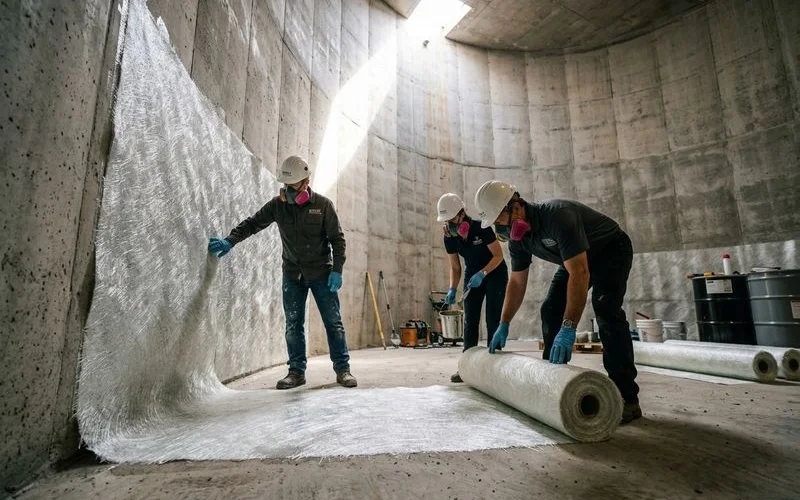
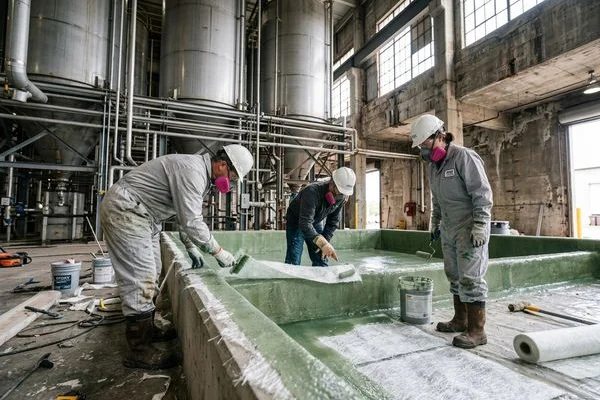
Our approach: All joints and cracks receive specific repair treatment, followed by fiberglass woven mat embedded in the first coat of the containment lining. The fiberglass mat provides crack bridging capacity — it can accommodate small movements without the lining above developing a pinhole. Mat reinforcement is applied at all joint locations as a standard practice, not an optional add-on.
Floor-to-Wall Transitions
The cove or fillet at the junction of the containment floor and the berm wall is a high-stress detail that is frequently applied incorrectly. If the coating bridges the corner without a formed cove, it spans a stress concentration point and typically cracks at the corner profile under thermal cycling. We form proper radius coves in all floor-to-wall transitions and embed fiberglass mat in the cove to ensure structural integrity of the detail.
Penetrations
Pipes, conduits, and structural elements penetrating through a containment structure are every containment engineer’s greatest concern. Each penetration is a potential bypass path for chemical to circumvent the coating system entirely. We install appropriate penetration collars, boot flashings, or mechanical seals depending on the specific penetration type and chemical exposure. All penetrations are spark-tested with particular attention because they are the highest-risk holiday locations.
Waterproofing for Below-Grade Structures
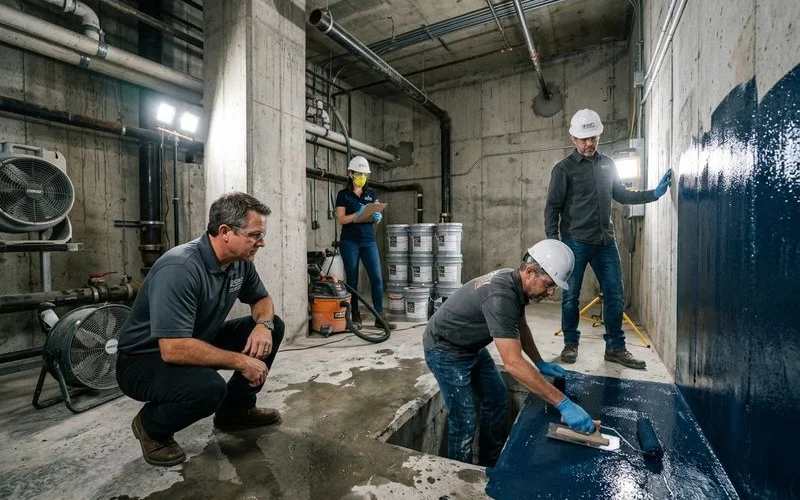
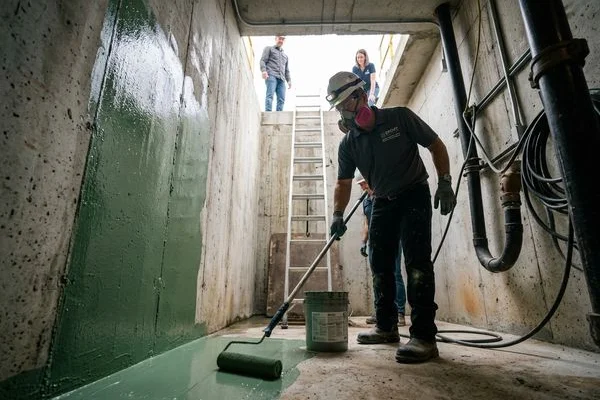
Not all containment challenges involve chemical resistance. Underground vaults, sumps, pump pits, and utility structures are regularly subjected to hydrostatic groundwater pressure that drives moisture through concrete joints and cracks. We apply waterproofing systems that address this different challenge:
Negative-Side Crystalline Waterproofing: For structures with active groundwater infiltration, crystalline waterproofing materials applied to the interior (negative side) react with water and cement to form insoluble crystals within the concrete pores, progressively sealing the substrate from within.
Positive-Side Membrane Systems: For new construction or dry substrate conditions, positive-side membrane systems applied to the exterior face of below-grade structures prevent moisture from entering the concrete in the first place.
Interior Coating Waterproofing: High-build epoxy or polyurethane systems applied to the interior of below-grade structures provide a physical barrier to moisture transmission while also offering the chemical resistance benefits appropriate for structures containing process fluids.
SPCC Compliance: Documentation That Satisfies Regulators
EPA SPCC regulations require that secondary containment systems be capable of containing the largest single vessel they protect plus freeboard for precipitation, and that they be free of cracks or gaps that would allow discharge. For regulated facilities, our containment lining projects include documentation specifically structured to support SPCC plan compliance:
- Written specification with chemical resistance rationale for selected coating chemistry
- Surface preparation records per SSPC standards with profile measurements
- Application records: product lot numbers, batch quantities, mixing ratios, application temperatures and humidity
- Film thickness measurements at specified intervals
- Holiday test report per NACE SP0188 with all holiday locations, repair records, and retest confirmation
- Photographs documenting all stages of surface preparation and application
This documentation package is provided at project completion and is structured for direct inclusion in your SPCC plan amendment records.
Tank Interior Coating: Immersion Service Requirements
Tank interior coating for chemical storage, potable water, wastewater, and fuel service is among the most demanding coating application work — and among the most consequential if done incorrectly. Interior coatings experience full chemical immersion 24 hours per day and any failure of the coating system exposes the tank shell to direct chemical damage.
Surface preparation for immersion service requires abrasive blasting of steel surfaces to SSPC-SP 10 or SP 5 — near-white or white metal — because any mill scale, rust, or contamination remaining under an immersion-service coating will cause premature failure. For concrete tanks, surface preparation must achieve ICRI CSP 5–6 minimum to ensure adequate mechanical anchor profile for the thick coating systems required.
We apply immersion-service coatings in multiple coats with full cure and holiday testing between each coat, ensuring that the final system has complete coverage, correct total film thickness, and no pinholes that would allow the contained chemical to reach the substrate.
Contact our containment coating specialists to discuss your specific chemical exposure profile and receive a technically appropriate lining specification for your containment or tank project.
What's Included
Our Containment & Tank Installation Process
Chemical Exposure Analysis
We begin every containment and tank coating project by obtaining the complete list of chemicals stored or handled in the containment area — including CAS numbers, concentrations, temperatures, and exposure duration scenarios. We cross-reference this list against the chemical resistance data for multiple coating system options before recommending a specification. The wrong coating chemistry will fail rapidly and potentially create a more serious release scenario than an uncoated substrate.
Substrate Investigation and Defect Mapping
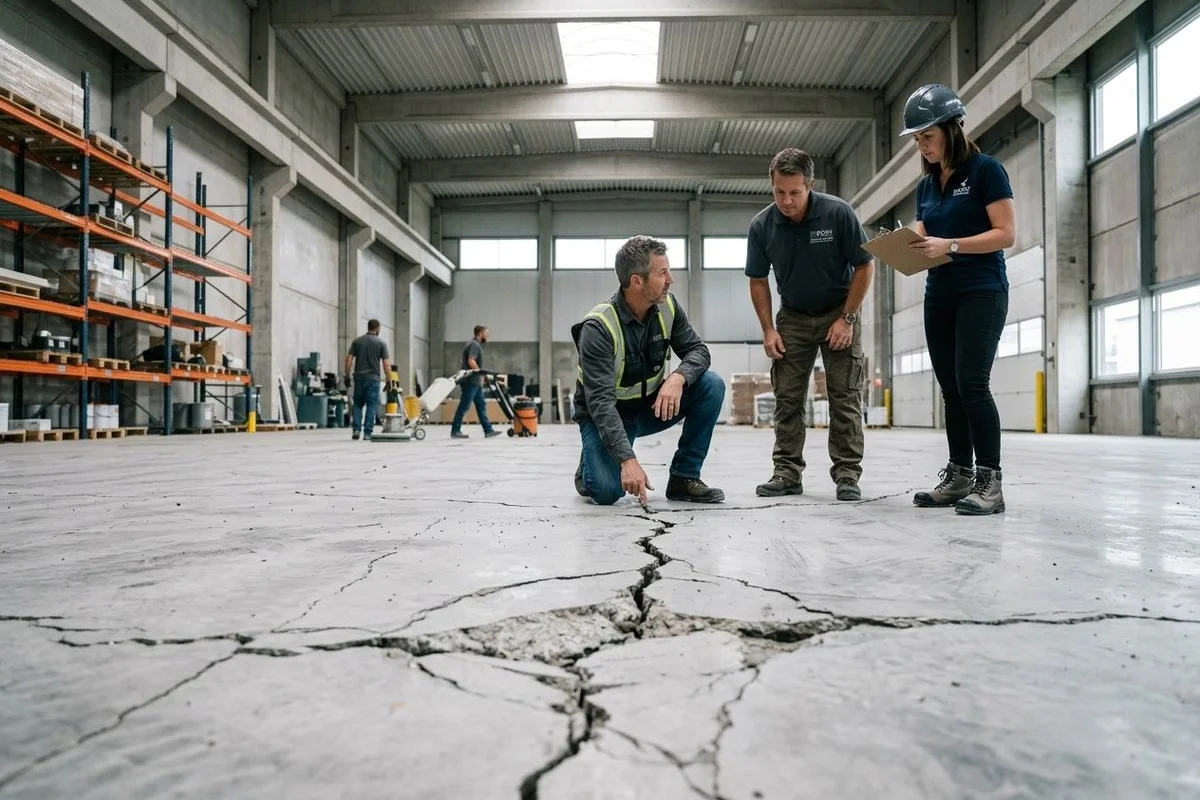
Containment structures and tank interiors are inspected for cracks, spalls, honeycombing, construction joints, penetrations, and existing coating failure. All defects are mapped and photographed. Moisture testing is performed — containment structures are often in contact with groundwater or subjected to hydrostatic pressure that must be addressed in the specification. Any active leaks are treated before coating proceeds.
Surface Preparation to SSPC Standards
Concrete containment surfaces are prepared by shot blasting, grinding, or high-pressure water jetting to achieve ICRI CSP 4–6 for thick coating systems. Steel surfaces are abrasive blasted to SSPC-SP 10 (Near-White Metal) or SSPC-SP 5 (White Metal) for immersion service. All joint details, penetrations, and transitions receive specific preparation treatment. Anchor profile is measured and documented before coating proceeds.
Repair and Crack Bridging
All cracks, construction joints, and penetration details are treated before the primary coating is applied. Positive-side waterproofing mortars seal active leaks. Structural cracks receive [repair treatment](/concrete-joint-repair/) appropriate to the movement classification. Penetrations are fitted with appropriate collars and flashing materials. Fiberglass mat reinforcement is embedded over all joints and transition details to provide bridging capacity in the primary coating system.
Primary Coating System Application
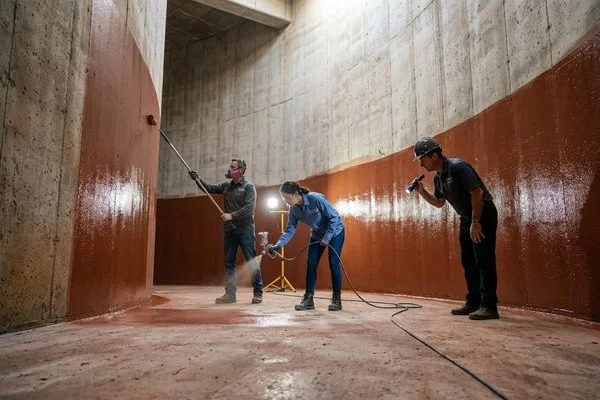
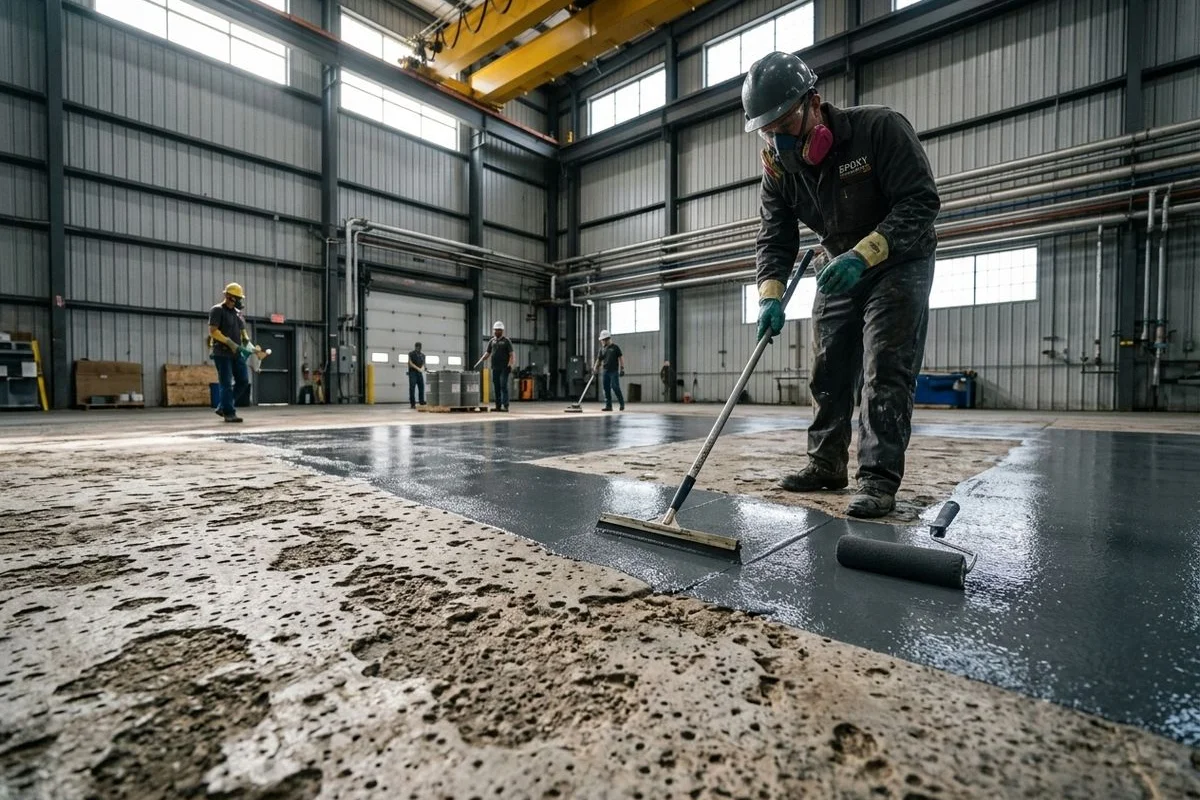
The specified coating system — novolac epoxy, vinyl ester, or standard epoxy depending on chemical exposure requirements — is applied in multiple coats to achieve the specified total dry film thickness (typically 40–120 mils DFT for primary containment applications). Each coat is inspected for defects before the subsequent coat is applied. Film thickness is measured at defined intervals throughout application.
Holiday Testing and Acceptance
Completed coating systems on containment structures and tank interiors are subjected to holiday (spark) testing per NACE SP0188 to identify pinholes or voids that would compromise the containment integrity. Any holidays detected are repaired and retested. A written test report documenting all test locations and results is provided. Water flood testing of containment berms is available as final verification.
Why Choose Epoxy Flooring Pro
Chemical Resistance Expertise
Selecting the correct coating chemistry for chemical containment is a technical decision that requires actual knowledge of polymer chemistry and chemical resistance data — not just catalog selection. We have application experience with all major containment coating types and can explain in detail why a specific system is appropriate for your chemical exposure profile.
NACE-Informed Application Standards
Our containment and tank coating work follows NACE (now AMPP) surface preparation and application standards — the recognized technical authority for industrial corrosion protection coatings. We specify SSPC surface preparation grades, measure anchor profiles, track coating application conditions, and conduct holiday testing per applicable NACE standards.
Detail Work is Our Strength
Containment coating failures almost always occur at details: joints, penetrations, coves, and transitions. These are the areas that require the most skill and attention. Our crews are specifically trained on detail treatment for containment applications — including fiberglass mat embedding, penetration collar installation, and cove formation — because we know that the field failures happen at the details.
Holiday Testing on Every Project
We perform holiday (spark) testing on every containment application as standard procedure — not as an optional add-on. We have observed projects where holiday testing found dozens of pinholes not visible to the naked eye. In a containment application, a single pinhole allows chemical penetration to the substrate. Testing is not optional.
Documentation for Regulatory Compliance
Secondary containment systems are subject to EPA Spill Prevention, Control, and Countermeasure (SPCC) requirements and state environmental regulations. We provide complete application documentation — surface preparation records, coating lot numbers, film thickness measurements, application conditions, and holiday test results — to support your regulatory compliance records.
Project Gallery
What Our Clients Say
"We needed to reline four chemical storage berms that had developed coating failures after exposure to sulfuric acid. Epoxy Flooring Pro assessed the chemical exposure correctly and specified a novolac epoxy system rather than the standard epoxy the previous contractor had used. That detail — the difference between standard and novolac — is exactly what was needed. The new lining has been in perfect service for 18 months and passed our last SPCC inspection."
"Our underground utility vault was leaking groundwater through hairline cracks in the concrete walls and floor. Their crew properly treated the active leaks, installed crack bridging membranes, and applied a full waterproofing and protective lining system. The vault has been completely dry for eight months. The photographic documentation they provided was excellent for our engineering records."
"Holiday testing after the first coat application revealed 12 pinholes we never would have found visually. Every one was repaired and retested before the next coat went on. That's the kind of quality control that matters on a chemical containment application. We trust this floor to contain whatever gets spilled on it, and it has proven that trust multiple times already."
Frequently Asked Questions
What is the difference between novolac epoxy and standard bisphenol-A epoxy for chemical containment?
How thick should a secondary containment coating be?
Can concrete containment structures be coated even if they show cracks or construction joints?
What is holiday testing and is it required for all containment coatings?
How do you approach tank interior coating projects where access is limited?
Get a Free Estimate for Containment & Tank
Our project managers are ready to assess your facility and recommend the optimal containment & tank solution.